
Why store-bought Kimchi often lacks the bacteria you need
Why store-bought Kimchi often lacks the bacteria you need usually comes down to processing, storage and what the label actually promises. The key point is simple: a tangy taste or a chilled shelf does not prove that live cultures remain.
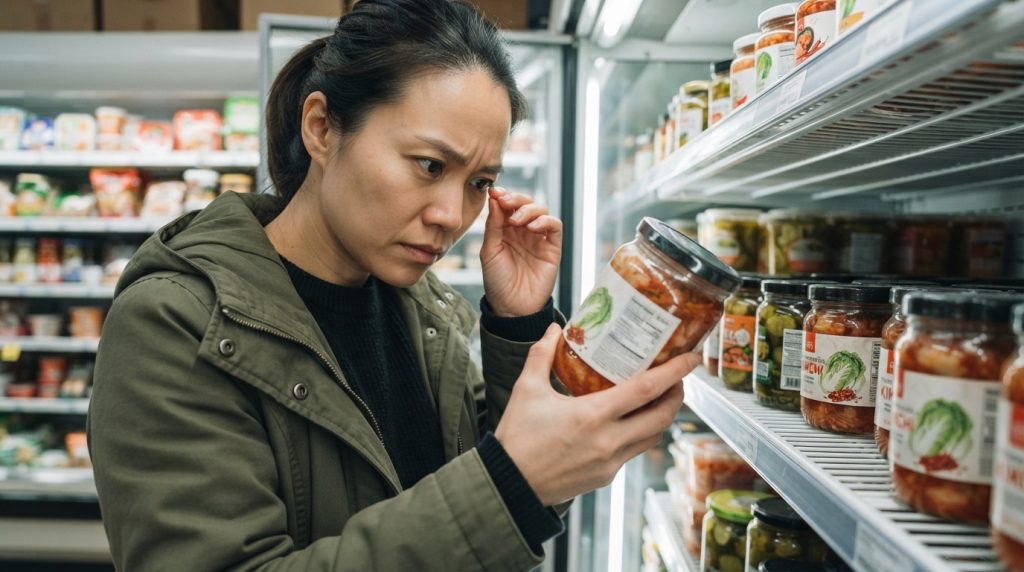
Key Takeaways
- Does store-bought Kimchi have good bacteria? It can contain live microbes, but processing and storage affect whether they remain in the finished product.
- What should you look for? Choose Kimchi whose maker clearly states that it is unpasteurised or contains live cultures.
- Is refrigerated Kimchi always live? No. Refrigeration is a helpful clue, not proof of how the Kimchi was processed.
- Do bubbles or sourness prove the cultures are alive? No. Both can occur during fermentation, but neither confirms that a product is unpasteurised or safe.
- How should you store Kimchi? Keep it refrigerated after opening, close the container and use a clean utensil.
- Does live-culture Kimchi guarantee a gut-health effect? No. A food with live microbes is not automatically a probiotic with a proven, specific benefit.
How fermentation creates Kimchi’s live bacteria
Kimchi gets its characteristic acidity through lactic acid fermentation. Bacteria use sugars naturally present in the vegetables and produce organic acids, while salt helps create conditions that favour fermentation rather than sterilising the food.
As the microbes make acids, Kimchi becomes more acidic. The Foods paper describes pH falling to 4.2–4.0 as organic acids accumulate during Kimchi fermentation. That reported range is not a fixed value for every recipe or a test of a retail jar: ingredients, salt, temperature and fermentation stage can all affect acidity.
That pH change is part of fermentation, but it does not prove that a product still contains live bacteria. Processing after fermentation, including heat treatment, can change whether those microbes remain viable.
Kimchi also does not have one fixed bacterial make-up. The vegetables, other ingredients, preparation and fermentation conditions all influence which microbes grow, so one jar’s live cultures may differ from another’s.
Sugar alone does not decide whether Kimchi ferments. The full recipe and processing method shape the conditions for microbial growth; other ingredients and preservatives can influence those conditions too.
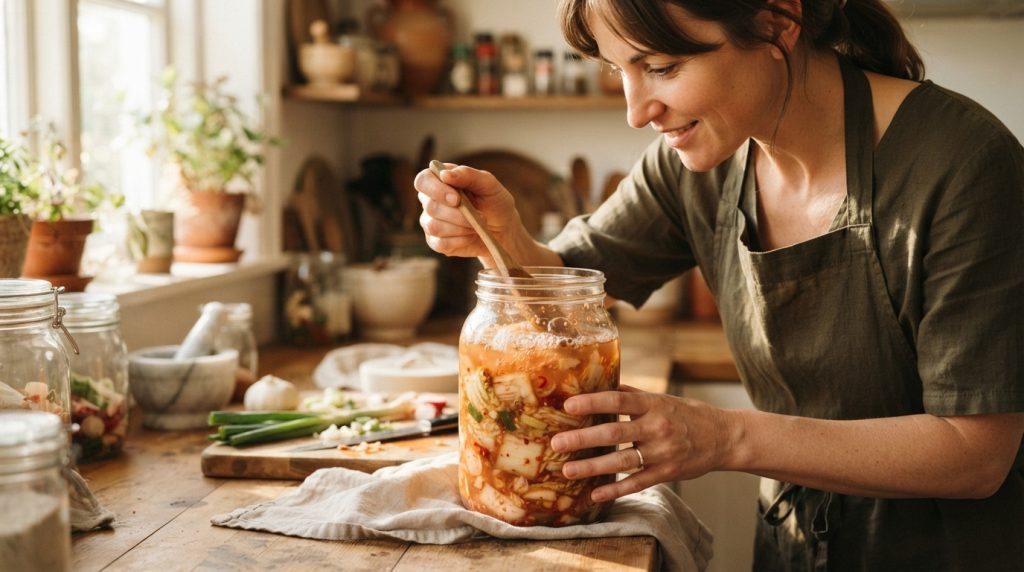
Why processing can leave little or no live culture
Pasteurisation uses heat to reduce microorganisms. Kimchi that has been pasteurised may keep much of its familiar flavour while losing the live cultures present before heating.
Shelf-stable processing can involve different methods, so a jar being shelf-stable does not tell you by itself whether the Kimchi was fermented, pasteurised or left with viable cultures. Likewise, a refrigerated product may still have been heat-treated before it reached the chilled shelf.
Vinegar pickling and lactic acid fermentation can both produce a sour taste, but they work differently. Vinegar pickling adds acid directly, while lactic acid fermentation creates acids through microbial activity.
That means sourness alone cannot tell you whether a product was naturally fermented or pickled with vinegar. The ingredients and processing details matter more than the sharpness of the first bite.
Some shelf-stable foods use preservatives or other processing steps to control microbial growth. Their presence or absence does not, on its own, confirm whether live cultures remain in a particular Kimchi.
Did You Know?
Firmicutes (57.9%) and Proteobacteria (36.3%) were the dominant phyla, whereas Levilactobacillus (19.2%) and Lactiplantibacillus (12.2%) were the most abundant genera.
Source: Frontiers in Microbiology
These figures describe the bacterial community reported in the cited research, not the amount of live microbes in a serving or a standard shared by all Kimchi. They cannot tell you whether a particular shop-bought jar is unpasteurised; the product’s processing and live-culture wording are more useful for that choice.
How to choose Kimchi with live cultures
For the clearest clue, look for a maker’s statement that the Kimchi is unpasteurised or contains live cultures. A general description such as fermented tells you about a process, but does not establish that viable microbes remain in the finished product.
Refrigerated Kimchi can be a useful place to start, but cold storage is not a guarantee of live cultures. Products can be heat-treated and then chilled, and storage conditions differ between products.
Read the wording alongside the ingredient list. References to vinegar, brine or fermentation can help explain how a product is made, but none of those words alone confirms that its cultures are alive at the point of purchase.
If sodium is a concern, compare nutrition panels using the same serving size; values are only comparable when the portions match. Salt is used in many Kimchi recipes, but sodium content does not tell you whether cultures survived processing. A lower-sodium option may still be heat-treated, and a live-culture claim does not by itself tell you its sodium level.
If the label leaves the processing unclear, ask the manufacturer directly whether the Kimchiwas pasteurised and whether live cultures remain in the finished product. That question is more useful than trying to infer viability from the jar’s position in the shop.
One more distinction: a fermented food containing live microbes is not automatically a probiotic product with identified strains and amounts shown to provide a particular health effect. The word probiotic makes a more specific promise than simply saying that microbes are present.
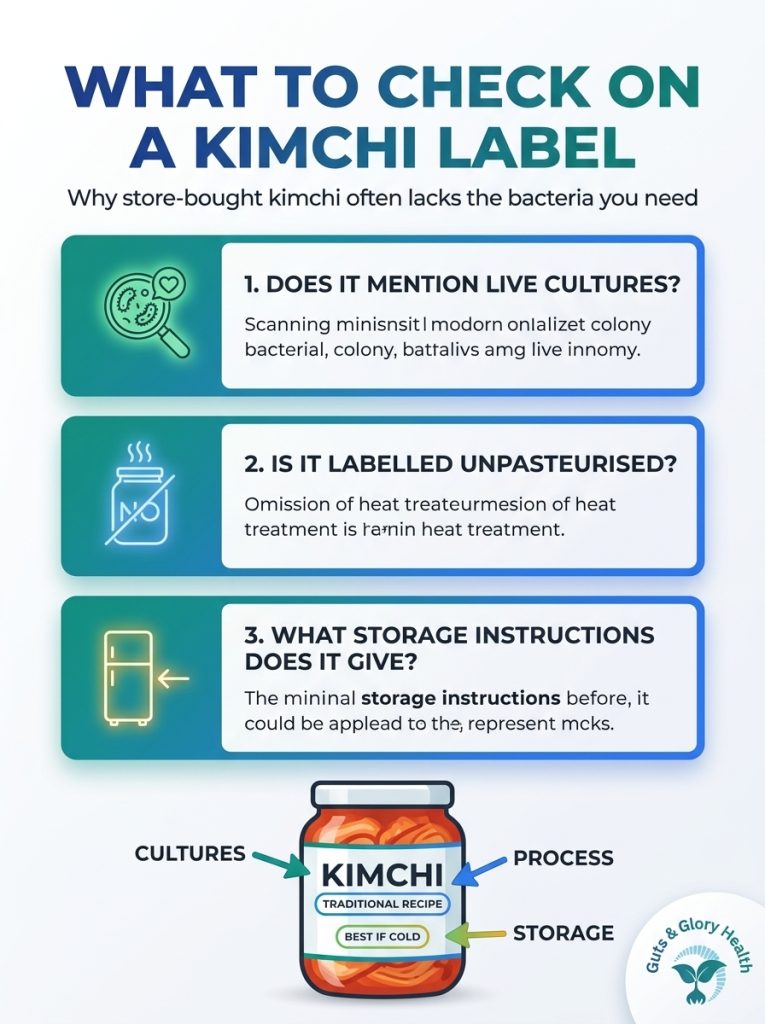
This infographic highlights what to check on a Kimchi label when looking for live bacteria. Use it as a guide when comparing store-bought options.
What bubbling, sourness and storage can tell you
Fermentation can continue after you buy Kimchi, especially if it is kept warm. Refrigeration slows microbial activity, but it can continue in the fridge.
The University of Georgia Cooperative Extension says visible bubbling may occur during the early stages of Kimchi fermentation, typically within the first 1 to 2 days at room temperature, as lactic acid bacteria metabolise sugars and produce carbon dioxide.
Bubbles, pressure or a hiss can reflect gas production, but they do not prove that a product is unpasteurised or safe to eat. Sourness can increase as fermentation proceeds, yet taste cannot confirm whether live cultures remain.
Once opened, keep Kimchi refrigerated, close the container and use a clean utensil each time. These habits help maintain its quality and limit the chance of introducing unwanted microbes.
Do not try to restart fermentation when you do not know how the Kimchi was processed or stored. Adding warmth or changing the conditions cannot reliably restore live cultures, and it can create avoidable food-safety uncertainty.
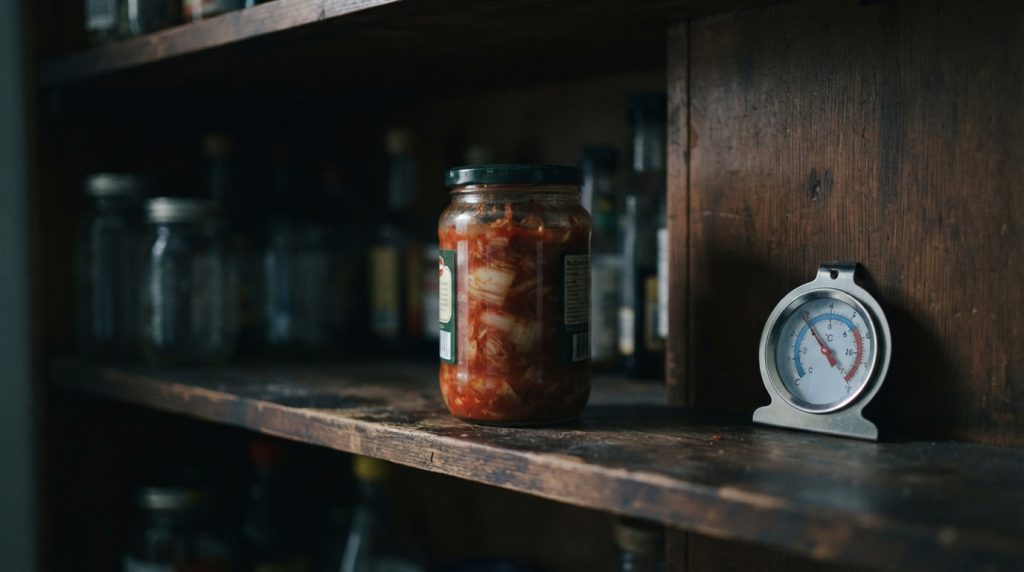
How to spot spoilage and handle Kimchi safely
Discard Kimchi if its container is bulging or leaking, its seal is damaged, you see mould or it has a rotten smell. Do not taste it to find out whether it is safe.
Active fermentation can produce carbon dioxide, so pressure or a hiss when opening an intact container may occur. That does not make visible swelling, a leak or a compromised seal safe: a bulging package can also indicate a problem, so discard it rather than relying on pressure, smell or taste to judge.
Follow the product’s storage and use-by instructions, and avoid leaving opened Kimchi warm for extended periods. Acidity and a sour flavour do not guarantee safety or rule out every food-safety risk.
Other warning signs can include an unexpected colour change or a slimy surface or markedly mushy texture. Kimchi can naturally soften and become more sour as it ferments, so those changes alone do not establish spoilage. If its appearance or texture seems abnormal, follow the product’s storage guidance and do not taste it to check.
To reduce the risk of food-borne illness, do not use bubbling, a hiss or sourness as a safety test. For home fermentation, use a reliable, tested method and follow its instructions rather than improvising the ingredients or process.
Did You Know?
Erwinia spp., Pseudomonas veronii, Pseudomonas viridiflava, Rahnella aquatilis, and Sphingomonas spp. were detected during the first 15 days of fermentation, whereas the last fermentation phase was dominated by Leuconostoc kimchi, together with Weissella soli.
Source: Foods
What Kimchi can and cannot promise for gut health
Live microbes in a fermented food do not automatically establish a probiotic effect. That depends on the particular strains, the amount consumed and evidence that those microbes provide a specific benefit.
Effects can vary with the product, the person and the wider diet, so Kimchi is not a guaranteed way to change your gut microbiome. It can be one part of a varied way of eating, rather than a stand-alone solution for microbiome diversity.
If your aim is to retain more live cultures, add Kimchi after cooking rather than heating it as part of the dish. Cooked Kimchi still brings its flavour and vegetables to a meal, even though heat reduces live microbes.
We like the fridge-first approach: choose foods you enjoy and build variety across your meals. For ideas that pair fermented foods with other nourishing ingredients, explore our gut-healthy recipe collection, or use our free microbiome food guide to plan more variety.
Frequently Asked Questions
Is the liquid in a Kimchi jar a source of live cultures?
It can contain microbes from the vegetables when the Kimchi is unpasteurised and actively fermented. The amount and types are not standardised, so the liquid is not a measured dose of any particular culture.
Is Kimchi a probiotic or a prebiotic?
Kimchi can contain live microbes, while its vegetable ingredients also provide fibre that gut microbes can use. Those features do not by themselves establish that a particular jar delivers a defined probiotic benefit.
Can Kimchi replace a probiotic supplement?
Not reliably when a supplement has been selected to provide a particular strain or measured amount for a specific purpose. A health professional’s recommendation for a named strain does not mean Kimchi provides the same strain or dose.
Are the live cultures in Kimchi the same as those in sauerkraut?
Both foods can involve lactic acid bacteria, but their microbial communities can differ. Vegetables, seasoning, preparation and fermentation conditions shape which microbes grow in each batch.
Can eating kimchi every day destroy gut bacteria?
Eating Kimchi does not mean that it destroys your gut bacteria. People differ in how they tolerate spicy, acidic or salty foods, so your own comfort and overall eating pattern matter.
Can you freeze Kimchi to keep its live cultures?
Freezing can change the number of viable microbes, so it is not a dependable way to preserve a specific live-culture amount. It can also soften the vegetables after thawing, making frozen Kimchi more suitable for cooked dishes where texture matters less.
What is the healthiest store-bought Kimchi?
There is no single healthiest store-bought Kimchi for everyone. If you want live cultures, choose one clearly described as unpasteurised or containing live cultures, and consider your preferences and tolerance for spicy, acidic or salty foods.
How to avoid botulism in Kimchi?
For homemade Kimchi, use a recipe written specifically for Kimchi fermentation rather than adapting one for a different food. For store-bought Kimchi, follow its storage instructions and discard it if the container is bulging, leaking or has a damaged seal; bubbles or sourness alone cannot establish safety.
Not a mystery
Why store-bought Kimchi often lacks the bacteria you need is not a mystery of taste: heat treatment, processing and storage can all affect live cultures. Look for clear unpasteurised or live-culture wording, keep opened Kimchi refrigerated and treat bubbles and sourness as clues, not proof.
And one gentle reminder: there is no single jar that guarantees a gut-health result. Enjoy Kimchi as one flavourful part of a varied diet, and let the wider pattern do the supporting.