
What the Vagus nerve actually does for your digestion: a clear guide
What the Vagus nerve actually does for your digestion is less like switching digestion on and more like helping the brain and gut coordinate. We’ll look at what the nerve signals, how it works alongside the gut’s own nervous system, and why common symptoms or self-stimulation claims don’t tell you whether it is working properly.
Key Takeaways
- How does information travel between the gut and brain? Sensory vagal fibres carry information from digestive organs towards the brain, while motor fibres carry signals from the brain towards some digestive organs.
- What digestive processes does the vagus nerve influence? It helps regulate stomach movement, relaxation as food arrives, emptying, secretions and digestive reflexes. It does not control digestion alone.
- What is the difference between the vagus nerve and the enteric nervous system? The vagus connects the brainstem with digestive organs; the enteric nervous system coordinates many local digestive actions within the gut.
- Can stress affect digestion? Yes. Changes in nervous-system activity can influence gut movement and sensations, but stress is only one possible influence.
- Do bloating, reflux or constipation prove vagus nerve damage? No. These symptoms are common and can have many causes.
- Can you activate the vagus nerve to cure a digestive disorder? Slow breathing may influence stress and autonomic activity, but it is not a proven cure for a digestive condition.
How the vagus nerve connects the brain and gut
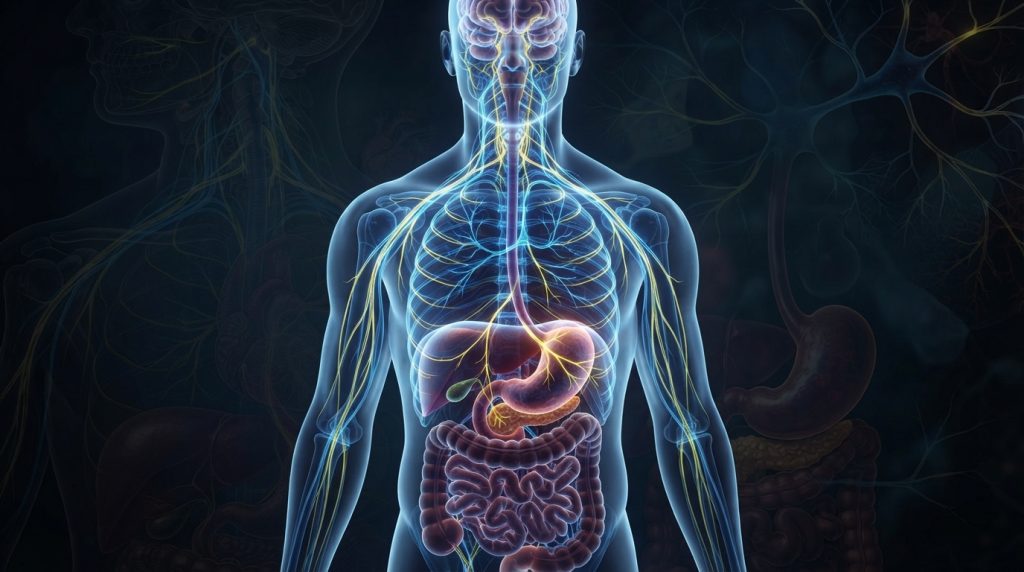
The vagus nerve is a cranial nerve that runs from the brainstem through the neck and chest to organs including the stomach and intestines. It is a communication route, not a tube that food travels through.
It carries signals in both directions. Vagal afferents carry sensory information from the digestive tract towards the brain, while vagal efferents carry signals from the brain towards digestive organs.
That sensory traffic can tell the brain about gut activity, including stretching as the stomach fills and changes in the digestive environment. The brain can use this information alongside signals from hormones and other nerves to coordinate responses such as fullness or changes in digestive activity.
Cold Spring Harbor Perspectives in Medicine describes the vagus nerve as a mixed nerve composed of 80% afferent fibres. In other words, the pathway carries substantial information from the body towards the brain, as well as commands in the other direction.
The vagus is part of the autonomic nervous system, which regulates many body processes that do not require conscious effort. Its digestive role is one strand of the gut-brain axis, a wider network that also includes other nerves, hormones and the gut’s own neural circuits.
What vagal signals influence during digestion
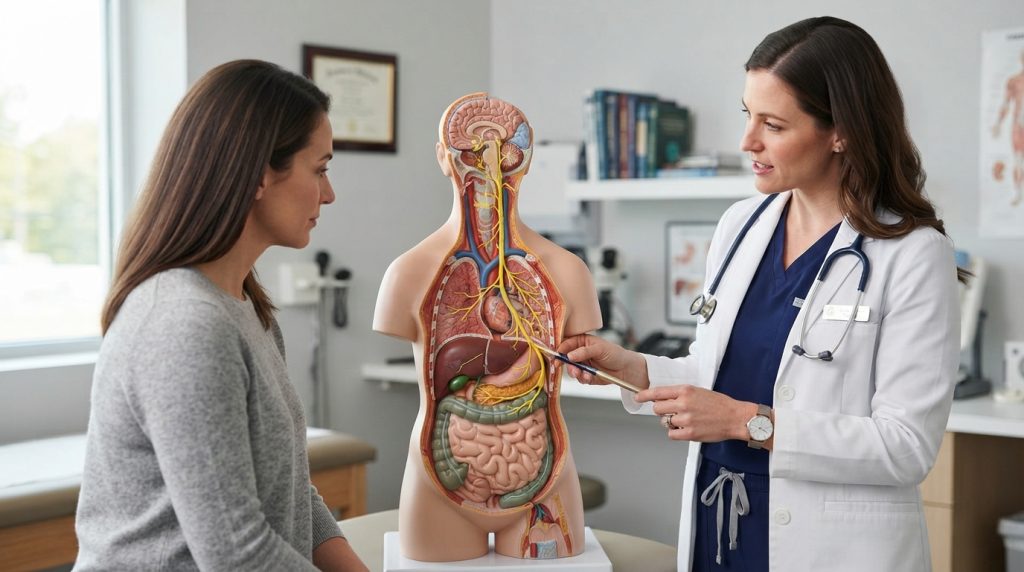
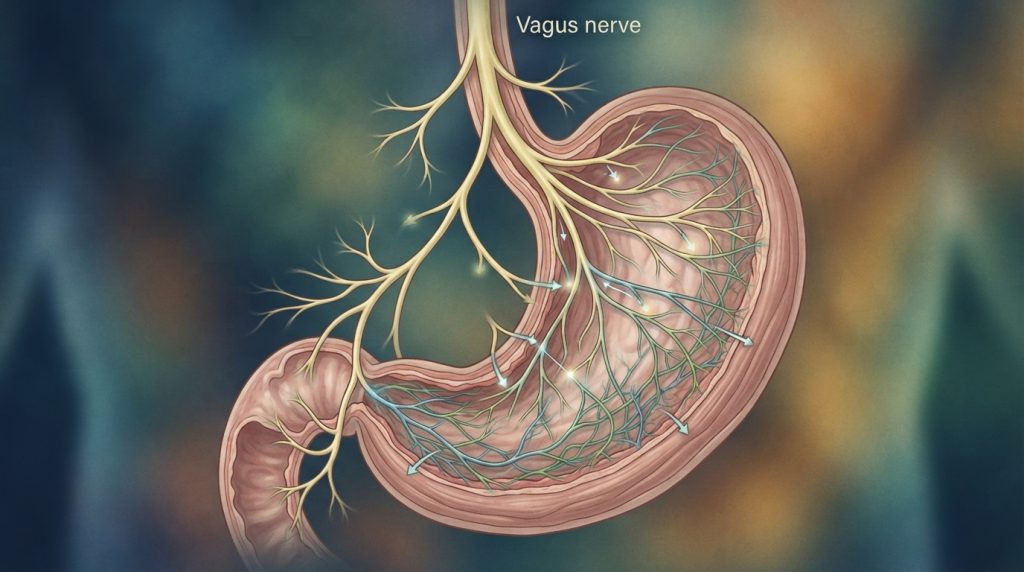
Vagal motor signals help regulate stomach movement and its relaxation as food arrives. They also contribute to the coordination of gastric emptying, the process by which stomach contents move into the small intestine.
These signals modulate digestive activity rather than acting as an on-off switch. The timing and movement of food through the digestive tract depend on several interacting controls, not just one nerve.
Vagal pathways also influence digestive secretions and reflexes. For example, information from the gut can prompt the nervous system to adjust activity, while local gut circuits and hormones contribute to the same processes.
This is why a change in vagal signalling does not automatically explain every change in digestion. Digestive motility and secretions are shaped by the vagus, the enteric nervous system, other autonomic pathways and the body’s chemical signals working together.
Did You Know?
The vagus contains approximately 70–80% sensory fibers, depending on the species.
Source: Gastroenterology
The enteric nervous system works alongside the vagus
The enteric nervous system (ENS) is a network of nerve cells within the digestive tract. It can coordinate local movement and secretion, even as it communicates with the brain and other parts of the nervous system.
The vagus takes a longer route between the brainstem and digestive organs. The ENS helps organise activity locally within the gut, so digestive regulation does not rely on every message travelling to the brain and back.
These systems work alongside one another rather than in isolation. The vagus can carry information between the gut and brain, while enteric circuits help manage nearby digestive activity.
Frontiers in Psychiatry estimates that the human enteric nervous system contains about 100–500 million neurons. That extensive network helps explain why digestion involves more than one pathway.
The parasympathetic nervous system, which includes vagal pathways to digestive organs, is another part of this wider control system. Its signals interact with local gut circuits, rather than replacing them.
Stress, appetite and the gut-brain connection
Stress can shift activity in the autonomic nervous system and change digestive sensations or movement. Some people notice that their gut feels different during stressful periods, but stress is one influence among many, not a universal cause of digestive problems.
Signals about stomach filling and gut activity can contribute to appetite regulation and satiety, the feeling of fullness after eating. Hormones, meal composition and other brain pathways also help shape hunger and fullness, so neither appetite nor meal size is controlled by the vagus alone.
You may come across the phrase low vagal tone in wellness discussions. It is not a diagnosis that can be established from a breathing pattern, mood or digestive symptom, and those experiences alone do not prove vagal dysfunction.
No particular food is established as directly damaging the vagus nerve. A food can still trigger symptoms for an individual, for example because of an intolerance or a diagnosed digestive condition, without that meaning the nerve has been harmed.
If a meal seems linked to discomfort, it can be more useful to notice the pattern and discuss it with a clinician than to label the vagus as the cause. Food-related symptoms can have different explanations, and the right interpretation depends on the person’s overall history.

What digestive symptoms can, and cannot, tell you
Impaired vagal pathways can be relevant to delayed stomach emptying, including gastroparesis. However, other causes can also affect how quickly the stomach empties, so the condition does not by itself establish vagus nerve damage.
Bloating, reflux, constipation, nausea and feeling full quickly are all common, nonspecific symptoms. None of them alone proves that the vagus nerve is damaged or that it is the source of the problem.
There is no single universal “vagus nerve test” that explains every digestive complaint. A clinician considers your history and examination, then selects tests that fit the problem they suspect.
For example, if delayed stomach emptying is suspected, assessment may focus on stomach function rather than trying to infer nerve damage from a symptom alone. The appropriate evaluation depends on what is happening and which conditions need to be considered.
Arrange medical assessment for symptoms that persist or worsen, repeated vomiting, difficulty swallowing, unexplained weight loss or signs of dehydration. These symptoms deserve attention because they can have causes that need specific evaluation and care.
Did You Know?
Seven randomized controlled trials investigating non-invasive VNS were included, with a total of 644 patients.
Source: Oxford Academic
Vagus nerve stimulation: medical treatment and self-help claims
Implanted vagus nerve stimulation uses a device placed under medical supervision and has established uses for certain conditions. It is not a routine treatment for general digestive complaints, and its medical use is different from trying a technique at home.
Non-invasive stimulation devices and at-home techniques are not equivalent to implanted treatment. Their evidence and clinical uses differ, so claims about a consumer device or a self-directed method do not establish that it treats a digestive disorder.
Slow breathing may affect autonomic activity or help with stress for some people. That does not show that the vagus has been “reset”, or establish slow breathing as a cure for a digestive condition.
A claimed vagus nerve reset is not a recognised medical procedure. Massage and other self-stimulation claims also do not, on their own, establish that a method can treat digestive disease.
If you are considering a stimulation device for a health condition, discuss it with a qualified clinician who can explain whether that approach is appropriate for you. For general digestive symptoms, it is more useful to assess the symptoms themselves than to assume that stimulation is the answer.
The vagus nerve’s role in digestion
What the Vagus nerve actually does for your digestion is help carry information between the brainstem and digestive organs, while contributing to stomach movement, relaxation, emptying, secretions and reflexes. It works alongside the enteric nervous system, hormones and other autonomic pathways; it does not run digestion by itself.
That distinction matters when symptoms appear. Bloating, reflux, nausea or constipation cannot diagnose vagus nerve dysfunction, and popular breathing or massage routines are not established cures for digestive disorders. If symptoms persist, worsen or include warning signs such as repeated vomiting or unexplained weight loss, seek clinical advice.
Frequently Asked Questions
Can vagus nerve damage cause hoarseness or difficulty swallowing?
Yes, injury affecting vagal branches can interfere with voice or swallowing because those branches help coordinate functions of the throat and larynx. Hoarseness and swallowing problems can also have other causes, so neither symptom identifies a vagal injury on its own.
Can gastroparesis happen without vagus nerve damage?
Yes. Gastroparesis can occur without confirmed vagus nerve damage, and causes can include diabetes, certain medicines or previous surgery, among other possibilities.
Can an MRI show whether the vagus nerve is working properly?
An MRI can show anatomy and may help identify certain structural problems, but it does not directly measure how well vagal signals are functioning. Whether imaging is useful depends on the symptoms and the question a clinician is investigating.
Does heart rate variability directly measure vagal tone?
No. Heart rate variability describes changes in the time between heartbeats, and it is influenced by several factors, including breathing and overall health; it is not a direct reading of vagal tone.
Can vagus nerve problems cause diarrhoea?
Changes in gut nerve signalling can affect digestive activity, but diarrhoea has many possible causes, including infection, medicines and digestive conditions. The symptom alone cannot show that the vagus nerve is responsible.
What should I track before discussing digestive symptoms with a clinician?
Note when symptoms happen, how long they last, their relationship to meals and bowel movements, and any recent changes in medicines or health. A clear timeline can help make the conversation more specific and guide what assessment may be useful.
How to activate the vagus nerve for digestion?
Slow, comfortable breathing may influence autonomic activity and help with stress, but it does not reliably “activate” the vagus nerve or treat digestive problems. The vagus nerve contributes to digestion as part of a broader system; it is not an on-off switch.