
Water kefir vs milk kefir: which actually fixes bloating?
Water kefir vs milk kefir: which actually fixes bloating? The honest answer is that neither is a guaranteed fix, but understanding what goes into each drink can help you choose one that better matches your diet and likely triggers.

Key Takeaways
- Milk kefir is fermented milk: it contains dairy proteins and usually some lactose, though fermentation reduces the lactose compared with unfermented milk.
- Water kefir is fermented sweetened water: it is generally dairy-free, but does not provide the protein found in milk kefir.
- Bloating has many possible causes, so a fermented drink cannot be expected to address them all.
- Neither type is proven to fix bloating for everyone. Probiotic effects can depend on the strain and the person, as we explain in our guide to probiotic strains for IBS.
- Choose based on what you tolerate and want from the drink, not on a promise of symptom relief. Our guide to kefir benefits and gut health offers more background on milk kefir.
- A small, one-at-a-time trial makes it easier to tell whether kefir suits you.
What kefir is and how the two types are made
Milk kefir is made by fermenting milk with a living culture of bacteria and yeasts, often called kefir grains. The finished drink retains milk proteins and usually contains some lactose, although fermentation reduces lactose compared with ordinary milk.
Water kefir is made by fermenting sweetened water with water kefir grains, which are also a culture of bacteria and yeasts. It is generally dairy-free, but it does not have the protein that milk kefir gets from milk.
Both drinks are fermented, but they are not interchangeable probiotic doses. Their microbes and nutrients vary with the culture, ingredients and fermentation conditions, so the name kefir alone does not tell you exactly what is in a particular drink.
For a creamy way to use milk kefir, our Mango kefir smoothie bowl blends kefir or live-culture yoghurt with almond milk or another milk, frozen mango, banana and honey, then adds granola and optional coconut, kiwi or pineapple. It shows how milk kefir can fit into a meal, while also making clear that the recipe includes several ingredients, not just kefir.
Our Blueberry kefir recipe takes a different route: frozen blueberries are cooked with sweetener, water and cornflour, then cooled and blended with kefir. The compote-and-kefir combination is a useful example of a drink whose final ingredients include more than its fermented base.
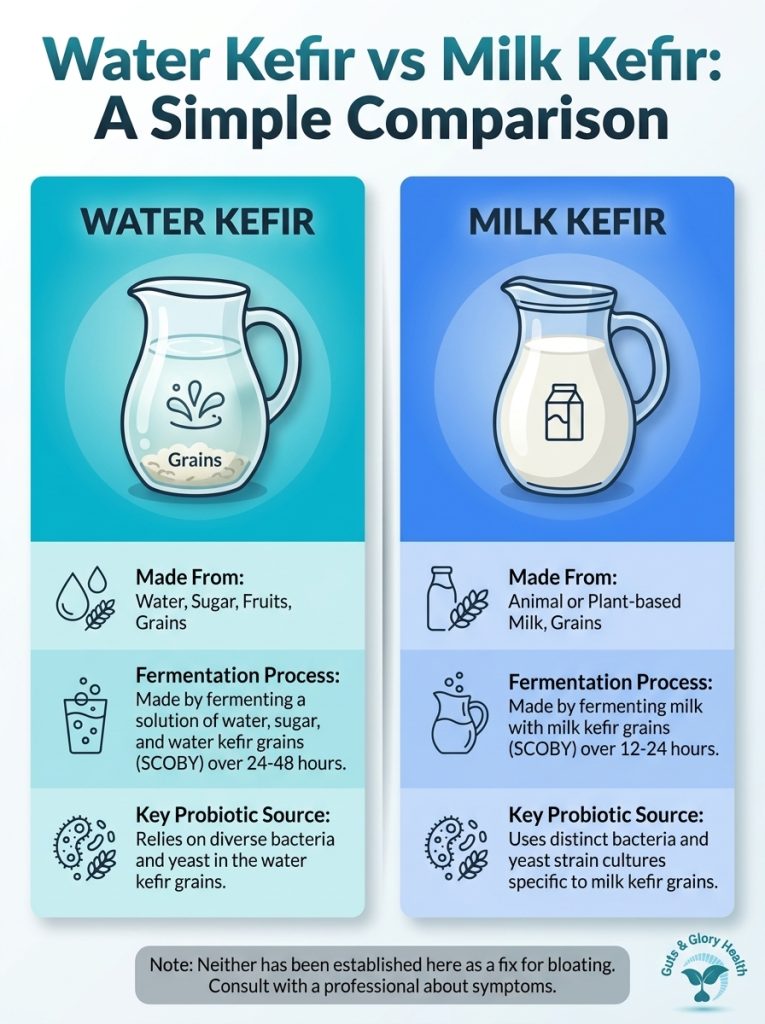
A simple comparison of water kefir and milk kefir, highlighting their differences and what to consider when exploring bloating relief.

Why neither type reliably fixes bloating
Bloating can follow swallowed air, constipation, food intolerance, gut sensitivity or the fermentation of certain carbohydrates in the gut. Those causes are different, so adding a probiotic drink cannot be expected to solve every one of them.
Evidence that kefir reliably relieves bloating is limited. A drink can contain live microbes without producing a noticeable improvement in your symptoms, and people can respond differently to the same fermented food.
Kefir can also bring on gas or discomfort, particularly if you start with a large serving or if its ingredients overlap with foods that already trigger symptoms for you. Milk kefir can be difficult for someone sensitive to lactose or milk, while sweetened water kefir may not suit everyone either.
If you want a fruit-and-kefir recipe to explore as food rather than as a treatment, Our Top 3 Strawberry Smoothie Recipes! includes banana-and-strawberry smoothies made with kefir or vanilla yoghurt. Smoothies can contain several ingredients at once, so keep that in mind when you are trying to work out which foods agree with you.
Persistent or recurring symptoms can have a wider range of explanations than a single drink. Our overview of digestive disorders and microbiome recovery offers further context on digestive health.
Which type may suit your likely trigger?
If milk or lactose tends to bring on your symptoms, water kefir avoids dairy and is the more suitable type to consider. It can still cause symptoms, though, because it is fermented and may contain residual sugar.
If you tolerate dairy, milk kefir may be an option because fermentation reduces its lactose. It is not lactose-free by default, and it still contains milk proteins, so reduced lactose does not make it suitable for everyone.
The practical difference is straightforward: choose water kefir when avoiding dairy is the priority, and consider milk kefir when you tolerate dairy and want a fermented milk drink that provides protein. If you have a milk allergy, milk kefir is not an appropriate choice.
Sourness and fermentation time alone do not determine how gentle a drink is. Fermentation changes lactose and sugars, but the final composition varies with the culture and conditions.
Our Strawberry kefir smoothie blends frozen strawberries with kefir, almond milk or another milk, vanilla extract and nut butter, with banana and sweetener as optional additions. It may suit someone who already enjoys a dairy-based smoothie, while its mix of ingredients is a reminder to consider the whole recipe when tracking symptoms.
For another perspective on fermented drinks and how their composition differs, read our comparison of kefir and kombucha. They are different drinks, with different ingredients and fermentation cultures.
| Your priority or likely trigger | More relevant option | What to bear in mind |
|---|---|---|
| Avoiding dairy | Water kefir | It is generally dairy-free, but residual sugar and fermentation may still affect your symptoms. |
| Choosing a fermented milk drink with protein | Milk kefir | It contains milk proteins and usually some lactose, even though fermentation reduces lactose. |
| Unclear food or drink triggers | Neither is an automatic first choice | Test one at a time so you can interpret your response. |

How to test Kefir without making symptoms harder to read
A small, steady trial gives you a clearer signal than changing several foods at once. Keep it gentle and simple:
- Try one type at a time. Begin with a few sips rather than a full glass, so any change is easier to connect with the drink.
- Keep other routines steady. Note the type, portion and timing, along with your symptoms; changing several things at once makes the cause harder to identify.
- Stop if symptoms worsen. Do not push through discomfort to finish a trial, and avoid milk kefir if you have a known milk allergy.
- Seek an assessment when needed. Kefir is not a substitute for medical advice if bloating is persistent, severe or accompanied by concerning symptoms.
A simple note on your phone is enough: record what you drank, how much, when you had it and what happened afterwards. Look for a pattern across occasions rather than treating one good or bad day as proof.
If symptoms include severe pain, blood in your stool, persistent vomiting or unexplained weight loss, contact a health professional promptly. The right next step is to understand the cause, not to keep switching fermented drinks.
Make the choice around your diet, not a promised cure
Choose water kefir when avoiding dairy matters most, or milk kefir when dairy is tolerated and you want a fermented milk drink with protein. Neither is proven to fix bloating for everyone, so let your own response guide whether either belongs in your routine.
If symptoms repeatedly follow a particular food or drink, identifying that pattern is more useful than moving between kefir types without tracking what happens. Consider the full ingredient list too, especially when kefir is part of a smoothie or sweetened drink.
Recurring bloating that affects daily life deserves a proper conversation with a qualified health professional. Possible causes include lactose intolerance, constipation and irritable bowel syndrome, and the right advice depends on your symptoms and health history.
Probiotics are not one-size-fits-all, and a fermented food is only one part of a varied diet. For a broader guide to choosing probiotic support, see which probiotic may be good for gut health.

Start Cautiously
Water kefir vs milk kefir: which actually fixes bloating? Neither drink can promise that, because bloating has many possible causes and fermented foods affect people differently.
Use the practical distinction to guide your choice: water kefir is generally dairy-free, while milk kefir contains dairy proteins and usually some lactose, alongside protein. Start cautiously if you try either, pay attention to your symptoms, and seek professional advice when bloating keeps returning or disrupts daily life.
Frequently Asked Questions
Can kefir cause diarrhoea?
Yes, kefir can be followed by loose stools in some people, particularly when the drink or its ingredients do not suit them. Persistent diarrhoea, dehydration, fever or severe pain calls for medical advice.
Can I heat kefir without affecting its live cultures?
Heating reduces the number of live bacteria and yeasts, especially if you boil the drink. If you want to preserve more live cultures in a dish, stir kefir in after cooking and let the food cool first.
Can water kefir be fermented longer to make it less sweet?
Fermentation uses some of the available sugar, so a longer ferment can taste less sweet. The result varies with the culture and conditions, and a longer ferment can also taste more acidic, so follow a reliable recipe and taste it as it ferments.
Is kefir safe to drink during pregnancy?
Choose pasteurised kefir during pregnancy, and avoid unpasteurised products because they can carry food-safety risks. Ask your midwife or another qualified health professional if you are unsure whether a particular product is suitable for you.
Can I drink kefir if I have a milk allergy?
Milk kefir is not suitable for a milk allergy because it retains milk proteins; fermentation does not make those proteins safe for someone with an allergy. Milk allergy is different from lactose intolerance, which involves the milk sugar rather than an immune reaction to milk proteins.
Created with AI assistance and reviewed by a human