
The ’30-30-3′ Microbiome Protocol: Your Science-Backed Daily Blueprint for a Thriving Gut
Did you know that 84% of consumers report being more interested in gut health products than in previous years? It’s no wonder that simple, evidence-based frameworks like the ’30-30-3′ Microbiome Protocol are capturing so much attention right now. We’ve been fascinated (to the point of obsession, honestly!) with what this three-part daily approach can do for the 100 trillion microbes living in your gut, and we’ve read the research so you don’t have to.
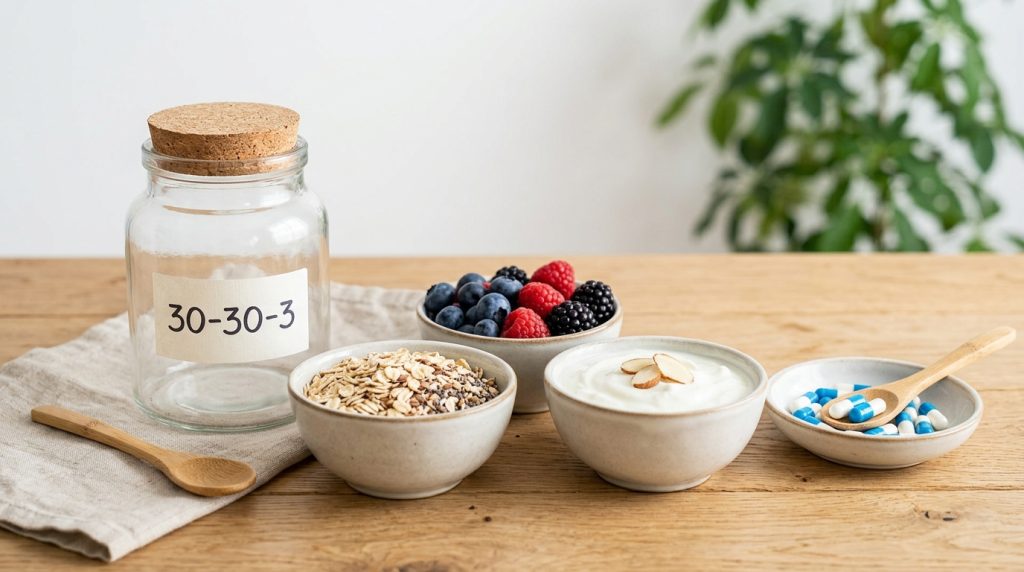
Key Takeaways
| Question | Answer |
|---|---|
| What is the ’30-30-3′ Microbiome Protocol? | A three-part daily framework: 30 different plant foods per week, 30 minutes of movement per day, and 3 fermented foods per day, designed to nourish and diversify your gut microbiome. |
| How quickly does the protocol work? | Studies show that diet can change your gut microbiome in as little as 3 days. Some people notice digestive and energy shifts within the first week. |
| Is the 30 plant foods target realistic? | Yes! Herbs, spices, nuts, seeds, legumes, grains, fruits, and vegetables all count. Our free microbiome food guide makes hitting 30 much easier than it sounds. |
| Does the protocol support skin health too? | Absolutely. The gut-skin axis means what you feed your 100 trillion microbes directly impacts your complexion, glow, and skin barrier. |
| Do I have to give up the foods I love? | Not at all. We believe in 80/20: eating healthy with just the right amount of cake thrown in. This protocol is about adding nourishing foods, not restriction. |
| Who is the ’30-30-3′ Microbiome Protocol best for? | Anyone who wants to support their physical and mental well-being through science-backed, practical daily habits, whether you’re new to gut health or already on the journey. |
| Where do I find gut-friendly recipe inspiration? | Right here! Our best microbiome recipes collection covers every meal of the day. |
What Is the ’30-30-3′ Microbiome Protocol, Exactly?
It’s a beautifully simple framework built on three numbers that, together, create a genuinely powerful daily habit stack for your gut. The ’30-30-3′ Microbiome Protocol breaks down like this:
- 30 different plant-based foods per week (to maximise microbial diversity)
- 30 minutes of moderate movement per day (to support gut motility and microbial balance)
- 3 servings of fermented food per day (to actively seed beneficial bacteria)
Each “30” and “3” targets a different lever of microbiome health. Together, they create a compounding effect that research is increasingly calling the gold standard for sustainable gut support.
We believe health shouldn’t be complicated, but it should be evidence-based. That’s exactly why this protocol resonates so deeply with us here at Guts & Glory Health.
Why the ’30-30-3′ Microbiome Protocol Actually Works
Your microbiome, the collection of bacteria living in your gut (and on your skin!), responds quickly to change. Studies show that foods that are good for our gut microbiome can change the microbiome in as little as 3 days. Mind-boggling!
The science behind the ’30-30-3′ Microbiome Protocol rests on three well-researched mechanisms:
- Diversity drives resilience. The landmark American Gut Project found that people who eat 30 or more different plant foods per week have significantly more diverse gut microbiomes than those who eat 10 or fewer. Microbial diversity is one of the strongest markers of overall gut health.
- Movement shifts the microbiome. Research published in Gut journal demonstrated that exercise independently increases levels of short-chain fatty acid (SCFA)-producing bacteria, even before dietary changes are made. SCFAs are the metabolites that fuel your gut lining, calm inflammation, and support your mood.
- Fermented foods seed beneficial bacteria. A Stanford University study (published in Cell) showed that a high-fermented food diet increases microbiome diversity and decreases inflammatory markers, all within 10 weeks.
We’ve read those research papers so you don’t have to, and the evidence pointing toward all three pillars working together is genuinely exciting stuff.
Did You Know?
84% of consumers report being more interested in gut health products than in previous years.
Source: EnzymeBio (Danone North America Survey)
The First ’30’ in the ’30-30-3′ Microbiome Protocol: 30 Plants Per Week
This is the pillar that surprises most people, because 30 sounds like a lot. But here’s the thing: everything counts. Herbs, spices, nuts, seeds, legumes, wholegrains, fruits, vegetables, teas, dark chocolate (yes, really!). Every single plant variety contributes unique fibres and polyphenols that feed different bacterial species in your gut.
Think of your 100 trillion microbes as a diverse community. Each bacterial species has its favourite “food.” The more variety you offer, the more species you support, and the more resilient and balanced your microbiome becomes.
Here are some practical bite-size tips for hitting 30 plants this week:
- Add a handful of mixed seeds to your morning yogurt (that’s 3-4 plants right there!)
- Swap one type of grain for a different one (try farro, buckwheat, or millet instead of always reaching for oats)
- Use a fresh herb as a garnish on every meal (parsley, coriander, basil, and dill all count separately)
- Try our gut health smoothie recipes for an easy way to pack 5-7 plants into one glass
- Make a big batch of soup using 8-10 different vegetables, legumes, and spices for the week
Our gut-friendly breakfast ideas are a brilliant starting point if you want to front-load your plant count in the morning.

The Second ’30’ in the ’30-30-3′ Microbiome Protocol: 30 Minutes of Daily Movement
This pillar often gets overlooked in gut health conversations, which is a shame because the research here is genuinely compelling. Exercise stimulates peristalsis (that’s the muscular contractions that move food through your digestive tract), reduces gut transit time, and actively shapes which bacterial species thrive in your microbiome.
The good news? The 30 minutes doesn’t have to be intense. Walking, yoga, cycling, dancing around your kitchen, it all counts.
Research from the University of Illinois found that lean, active individuals had significantly higher levels of butyrate-producing bacteria compared to sedentary individuals, and butyrate is one of the most important SCFAs for gut lining integrity and reducing inflammation.
We love this pillar of the ’30-30-3′ Microbiome Protocol because it’s the most democratic. You don’t need a gym membership. You don’t need kit. You just need to move your body, consistently, every day.
“The microbiome responds quickly to change. And movement is one of the fastest levers you can pull, before you even change a single thing on your plate.”
The ‘3’ in the ’30-30-3′ Microbiome Protocol: 3 Fermented Foods Daily
This is where things get really exciting. Fermented foods are alive with beneficial bacteria (probiotics), and eating them consistently means you’re actively seeding your gut with new microbial allies, every single day.
Three servings might sound like a challenge, but portions here are small. A tablespoon of sauerkraut, a 150ml glass of kefir, a small pot of live yogurt, a few spoons of kimchi: these are all “one serving.” It’s genuinely achievable!
Here are our favourite fermented foods to rotate through your week:
- Kefir (dairy or water-based): One of the most probiotic-dense foods available
- Live yogurt: Check the label for “live and active cultures”
- Sauerkraut: Buy refrigerated, not shelf-stable (the live cultures survive better)
- Kimchi: Packed with Lactobacillus species and a brilliant side dish
- Kombucha: A naturally fizzy fermented tea that counts as a serving
- Miso: Stir into soups at the end of cooking to preserve the live cultures
- Tempeh: A fermented soy product that works beautifully in our gut-healthy dinner recipes
Fueling your glow from the inside out, one spoonful at a time.
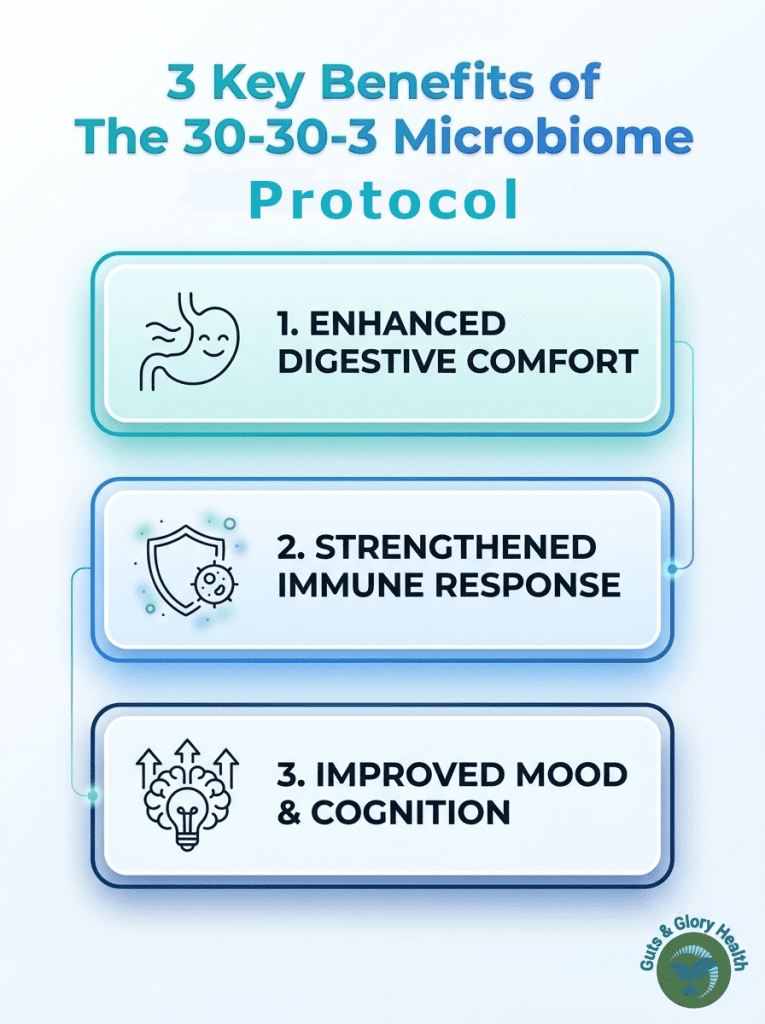
The 30-30-3 microbiome protocol distilled into three core benefits. Learn how these steps support gut health and overall wellbeing.
How the ’30-30-3′ Microbiome Protocol Supports Your Skin (The Gut-Skin Axis)
One of the most mind-boggling things we’ve discovered in our research is how powerfully the gut-skin axis connects what’s happening in your digestive tract to what shows up on your face and body. The gut and skin are in constant communication via the immune system, the nervous system, and the bloodstream.
When your microbiome is diverse and thriving (as it becomes when you follow the ’30-30-3′ Microbiome Protocol consistently), the ripple effects reach your skin. Reduced systemic inflammation means fewer flare-ups. More diverse bacterial populations mean stronger skin barrier function. More SCFAs mean calmer, more resilient skin.
It impacts your mood, skin, sleep, and more. That’s not an overstatement, that’s what the science is showing us, and it’s exactly why we’re so passionate about sharing it.
If you want to dive deeper into the skin side of this equation, our skin microbiome guide is a wonderful companion read to this protocol.
Did You Know?
60.4% of registered dietitians predict gut-boosting products will be the top driver of food purchases in the near future.
Source: EnzymeBio 2025
Building Your ’30-30-3′ Microbiome Protocol Day: A Practical Template
One of the most common questions we get is: “How do I actually fit all of this into a normal day?” Here’s a simple, realistic template that works beautifully without overhauling your life.
Morning:
- Breakfast: Live yogurt with mixed berries, mixed seeds, and a drizzle of honey (counts as 4-5 plants + 1 fermented food serving)
- Movement: A 30-minute walk before or after breakfast, done!
Midday:
- Lunch: A hearty lentil soup with 6+ vegetables and a side of sauerkraut (counts as 7-8 plants + 1 fermented food serving). Our gut-healthy soups collection has brilliant inspiration here
- Snack: A small glass of kombucha (1 fermented food serving, done by mid-afternoon!)
Evening:
- Dinner: A plant-rich stir-fry or chili using 5-6 different vegetables, legumes, and wholegrains. Our lunch and dinner recipe pages are full of microbiome-friendly ideas that take 30 minutes or less
By the end of a day like that, you’ve likely hit 15-20 of your 30 weekly plants. Spread that across 7 days and you’re comfortably over your target without even trying hard.

Common Mistakes to Avoid When Starting the ’30-30-3′ Microbiome Protocol
We’ve seen a few patterns when people first try this protocol, and we want to flag them so you can sidestep the frustration.
- Introducing too much fibre too fast. If you’re currently eating a low-fibre diet, ramp up your plant diversity gradually over 2-3 weeks. Your gut bacteria need time to adapt, and going from 5 to 30 plants overnight can cause bloating.
- Buying the wrong fermented foods. Shelf-stable sauerkraut and pickles that sit in the non-refrigerated aisle have typically been heat-treated. This kills the live cultures. Always look for refrigerated, unpasteurised versions.
- Treating movement as all-or-nothing. Three 10-minute walks count. A 30-minute yoga session counts. It doesn’t have to be one continuous block to have a positive effect on your microbiome.
- Forgetting herbs and spices. This is the easiest way to boost your plant count that people consistently overlook. Each different herb and spice is a separate plant. Garlic, turmeric, cumin, oregano: every one counts!
- Expecting overnight results. The 3-day microbiome shift is real, but building a genuinely diverse and resilient microbiome is a longer journey. Consistency over weeks and months is what creates lasting change.
For even more food ideas to keep things interesting, our gut-healthy snacks collection is a brilliant resource for hitting your plant count between meals.
The ’30-30-3′ Microbiome Protocol and Mental Well-Being
We’d be remiss not to mention the gut-brain axis here, because it’s one of the most exciting areas of microbiome research right now. Your gut produces around 90% of your body’s serotonin. The 100 trillion microbes living there directly influence neurotransmitter production, stress hormone regulation, and even sleep quality.
The ’30-30-3′ Microbiome Protocol addresses all three levers of this axis simultaneously. Diverse plants feed the bacteria that produce mood-regulating metabolites. Movement reduces cortisol and has been shown to positively shift the gut-brain communication pathway. Fermented foods introduce bacteria that research is linking, increasingly, to reduced anxiety markers.
It impacts your physical and mental well-being more than most people realise. We find this genuinely awe-inspiring every time we revisit the data.
Why the ’30-30-3′ Microbiome Protocol Is Worth Starting Today
The ’30-30-3′ Microbiome Protocol is, at its heart, a plain-English guide to nourishing the most important ecosystem in your body. Three evidence-based pillars, each one backed by genuinely compelling science, each one achievable within your everyday life without restriction or fear-mongering.
We’ve been fascinated to the point of obsession with the research behind this framework, and we share the science here because we genuinely believe it can support your physical and mental well-being in ways that feel sustainable and even joyful. This isn’t about perfection. It’s about consistently giving your 100 trillion microbes the diversity, movement, and live cultures they need to thrive.
Ready to put the ’30-30-3′ Microbiome Protocol into action? Download our free microbiome food guide and start building your plant list today. Your gut (and your skin, your mood, and your energy) will thank you for it!
Frequently Asked Questions
What does the ’30-30-3′ Microbiome Protocol actually involve day-to-day?
The ’30-30-3′ Microbiome Protocol involves eating 30 different plant foods across a week, doing 30 minutes of movement each day, and consuming 3 servings of fermented food daily. In practice, this looks like diversifying your meals with different vegetables, grains, legumes, herbs, and spices, adding a short daily walk or yoga session, and including a small serving of live yogurt, kefir, or sauerkraut with at least three meals.
How long does it take to see results from the ’30-30-3′ Microbiome Protocol?
Research shows that diet can shift your gut microbiome composition in as little as 3 days. However, most people following the ’30-30-3′ Microbiome Protocol report noticeable improvements in digestion, energy, and skin within 2-4 weeks of consistent practice. Building a truly resilient, diverse microbiome is an ongoing process rather than a short-term fix.
Is the ’30-30-3′ Microbiome Protocol backed by science?
Yes, each element of the ’30-30-3′ Microbiome Protocol is supported by peer-reviewed research. The 30 plants target draws from the American Gut Project, the movement pillar is supported by studies published in the journal Gut, and the fermented foods recommendation aligns with a landmark Stanford University study published in Cell. We’ve read the research papers so you don’t have to, and the evidence is genuinely compelling.
Can the ’30-30-3′ Microbiome Protocol help with skin issues like acne or eczema?
Via the gut-skin axis, a healthier and more diverse gut microbiome can reduce systemic inflammation, which is a key driver of conditions like acne, eczema, and rosacea. The ’30-30-3′ Microbiome Protocol directly supports this pathway by feeding beneficial gut bacteria through plant diversity and fermented foods. Results vary by individual, but the connection between gut health and skin health is one of the most exciting areas of current microbiome research.
Do herbal teas and spices really count toward the 30 plants in this protocol?
Absolutely! In the ’30-30-3′ Microbiome Protocol, each unique plant source counts as one of your 30, including herbs, spices, teas, nuts, seeds, and wholegrains. A single meal containing garlic, turmeric, cumin, black pepper, and fresh coriander already contributes 5 plants to your weekly tally. This is one of the most surprising and encouraging aspects of the protocol for people who are just starting out.
Is the ’30-30-3′ Microbiome Protocol suitable for beginners with no gut health experience?
The ’30-30-3′ Microbiome Protocol is actually designed with simplicity in mind, making it one of the most accessible entry points into gut health for beginners. Rather than eliminating foods, it focuses on adding things: more plants, more movement, more fermented foods. If you’re starting from a low-fibre baseline, we recommend increasing your plant intake gradually over a few weeks to let your microbiome adapt comfortably.
What are the best fermented foods to start with for the ’30-30-3′ Microbiome Protocol?
For beginners following the ’30-30-3′ Microbiome Protocol, live yogurt and kefir are the easiest starting points because they’re widely available, mild in flavour, and pair with breakfast foods naturally. Sauerkraut and kimchi are excellent next steps, while kombucha offers a fizzy, enjoyable way to hit your third daily serving. Always choose refrigerated, unpasteurised versions to ensure the live cultures are still active when they reach your gut.